Pinyin initial: "b"
/p/
The Pinyin initial "b" is used in the first half of Pinyin syllables. In MandarinBanana's mnemonic system, "b" belongs to the group of Pinyin initials which are represented in mnemonics by men. You can visit the Pinyin index to see all Pinyin syllables from this mnemonic group, or to see all Pinyin syllables "b" can appear in.
Pronunciation Tips
The “Cheat Code”
Think of b as a very light, unaspirated “p”—like the p in “spin,” not the p in “pin.”
Mouth Mechanics (step-by-step)
- Close your lips gently (both lips together), as if you’re about to say p/b in English.
- Build a small amount of air pressure behind the lips, but do not push it out hard.
- Release the lips quickly to start the syllable.
- Key test: when you release, there should be little to no puff of air.
- If you hold a tissue in front of your mouth, it should barely move.
- Immediately move into the vowel/final (like -a, -ai, -ao, -an, -ang, -o, -ei, -en, -eng).
- Keep your voice relaxed: this initial is produced with minimal breathiness—clean and crisp.
English Approximation (how to get close)
English doesn’t have this sound as a standard “p” at the start of a stressed word because English p is usually said with a strong puff of air. The closest match is English p after s, where the puff is naturally reduced.
Use these approximations:
- “spin” — the sound of p in spin is close to Mandarin b.
- “spot” — the p in spot is close.
- “speak” — the p in speak is close.
How to modify an English sound to match Mandarin b:
- Start from English p, then remove the puff of air.
- Keep the lips-and-release of p, but make it soft and tight, not explosive.
Common Mistakes (English speakers)
- Adding a puff of air (aspiration): English speakers often pronounce b like a strong English p (“pa!”). Mandarin b should be much less airy.
- Voicing it like English “b”: Some learners try to make it fully like English b (strongly voiced). Mandarin b is typically less “buzzy” than English b at the start of a word; focus on low air + quick release, not heavy voicing.
- Over-pressing the lips: If you clamp down too hard, the sound gets tense. Aim for firm but relaxed.
Practice Pairs (visualizing the sound)
These English words are approximations meant to cue the feel (especially the low-air “sp-” type p).
| Pinyin syllable | English cue (approx.) | What to copy from English |
|---|---|---|
| ba | “spa” (as in “spa”) | the p after s (low puff), then open a |
| bo | “spoke” (start of “spoke”) | the p after s, then a rounded o-type sound |
| bai | “spy” | the p after s, then glide toward an “eye” sound |
| bei | “spay” | the p after s, then “ay” glide |
| bao | “spow!” (like “pow,” but with low puff) | keep the p light; then “ow” glide |
| ban | “spawn” (start) | light p, then a, end with n-type closure |
| ben | “spun” (start) | light p, then a relaxed “uh” sound, end with n |
| bang | “spong(e)” (start) | light p, then open a, end with ng (back of tongue) |
| beng | “spung” (made-up cue) | light p, relaxed “uh,” end with ng |
Note: English cues are only to help you not aspirate. The vowels/finals in Mandarin have their own targets; your main job here is making the initial b clean and low-air.
Comparisons & caveats (similar Pinyin sounds)
b vs p (most important contrast)
- b = less air (unaspirated).
- p = more air (aspirated), like the strong p in English “pin.”
Quick self-check: Put your hand or a tissue in front of your mouth.
- Saying pa with p should create a noticeable puff.
- Saying ba with b should create little to no puff.
b vs English “b”
English b is often strongly voiced and can feel “heavier.” Mandarin b should feel lighter, with emphasis on crisp lip release and minimal air, not on making it extra buzzy.
b is always written “b” even though it may sound like “p” to you
Many beginners hear Mandarin b and think it’s p. That’s normal—because Mandarin is contrasting airiness, not the English-style b/p voicing contrast. Train your ear to listen for the puff: p has it, b doesn’t.
Syllable note (reading help)
When you see b + (a, ai, ao, an, ang, ei, en, eng, o), keep the same b each time: lips close → tiny pressure → quick release → no strong burst of air.
Pinyin with b
Mnemonics for b
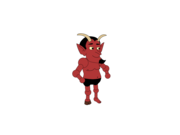
B is for Beelzebub.

Prompt snippets
Beelzebub is a physically imposing, ancient, demonic lord with a deep burgundy, textured, beetle-like exoskeleton covering large portions of his body. He possesses two large, tattered, fly-like compound wings with dark, iridescent black and green veining protruding from his shoulders. On his head, massive, ribbed, black horns curve backward, framing a face with four red, glowing, multi-faceted eyes and multiple pincer-like mandibles around his mouth. A long, prehensile, black fly tail extends behind him.
Characters with b