Pinyin initial: "k"
/kʰ/
The Pinyin initial "k" is used in the first half of Pinyin syllables. In MandarinBanana's mnemonic system, "k" belongs to the group of Pinyin initials which are represented in mnemonics by men. You can visit the Pinyin index to see all Pinyin syllables from this mnemonic group, or to see all Pinyin syllables "k" can appear in.
Pronunciation Tips
The “Cheat Code”
Think of the k in “key” or “kite,” but with a clear, noticeable puff of air right after the release.
Mouth Mechanics (step-by-step)
- Open your throat and relax your jaw (don’t tense up).
- Raise the back of your tongue so it firmly touches the soft back part of the roof of your mouth (the area you naturally use for an English “k”).
- Keep lips relaxed (they don’t form the sound; they only get ready for the vowel after).
- Build a tiny “stop” of air behind the tongue closure (like holding your breath for a split second).
- Release the tongue quickly—and let a strong puff of air escape immediately after the release.
- Start the vowel right after the puff (ka-, ke-, kai-, kao-, kou-, kan-, ken-, kang-, keng-).
- The key feeling: release + air burst + vowel.
A quick self-check: hold your palm 2–3 inches in front of your mouth. When you say Chinese k, you should feel a distinct burst of air.
English Approximation (how to get close)
Chinese k is most similar to the aspirated English k (the “strong” kind), especially at the start of a stressed syllable.
Good approximations:
- “kite” — the k at the beginning (the puff of air after k is what you want).
- “key” — the k at the beginning (again, aim for that airy burst).
- “call” — the k/c at the beginning (use the beginning sound, not the vowel quality).
How to modify your English k to match Chinese k:
- Make the puff of air more intentional and cleaner, like you’re trying to briefly “fog” a tiny spot on a window right after the k release.
- Keep it one clean consonant: k + vowel, not “kuh-” with an extra little vowel inserted.
Common Mistakes (English speakers)
- Not enough air (sounds like Chinese “g”): English speakers sometimes use a softer k that lacks the strong puff, making it drift toward an unaspirated sound.
- Adding an extra vowel: Saying “kuh-a” instead of “ka” (one smooth syllable).
- Making it too harsh or throaty: The sound is made by the back of the tongue, not by squeezing the throat.
- Overdoing it into a “kh” hiss: You want a puff, not a long noisy friction sound.
Practice Pairs (visualizing the sound)
These English words are approximations—use them to copy the initial k + strong air burst, then switch immediately into the Pinyin vowel.
| Pinyin syllable (initial focus) | English approximation | What to copy from English |
|---|---|---|
| ka- (ka1/ka3) | “kite” (start) | The k release + puff of air |
| ke- (ke1/ke2/ke3/ke4) | “key” (start) | The strong, airy k (ignore vowel differences) |
| kai- (kai1/kai3/kai4) | “kite” (start) | The initial k and its aspiration |
| kao- (kao1/kao3/kao4) | “cow” (start) | The k aspiration + quick move into an “ao”-like glide |
| kou- (kou1/kou3/kou4) | “coat” (start) | The k aspiration (ignore final t) |
| kan- (kan1/kan3/kan4) | “con” (start) | The k aspiration (ignore vowel quality; end with -n) |
| ken- (ken3/ken4) | “ken” | The k aspiration; keep it one syllable |
| kang- (kang1/kang2/kang4) | “kong” (start) | The k aspiration; end with -ng |
| keng- (keng1) | “kung” (start) | The k aspiration; end with -ng |
Tip while practicing: whisper the syllable first to exaggerate the air burst, then say it normally while keeping the same airflow.
Comparisons & Caveats (don’t confuse it with similar sounds)
k vs. g (the most important contrast)
- Chinese k is aspirated: you should feel a strong puff of air after release (as in the provided syllables: ka, ke, kai, kao, kou, kan, ken, kang, keng all begin with a clearly “breathy” k).
- Chinese g (a different initial) is typically not released with that strong puff. To an English ear, it can sound “closer to k,” but the real difference is airflow: k = strong puff, g = little to no puff.
k vs. h
- k has a complete stop first (tongue blocks air, then releases).
- h is continuous air without a full stop. If you turn your k into a long breathy sound, it can start to resemble h—avoid that.
k vs. q / j / x (don’t move the tongue too far forward)
- k is made with the back of the tongue.
- q/j/x (other initials) are made with the front/middle of the tongue and have a very different “sharper” feel. If your k starts to sound “too bright” or “too hissy,” you may be drifting forward.
Pinyin with k
Mnemonics for k
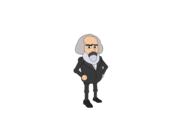
K is for Karl Marx.
Prompt snippets
Karl Marx is a stocky, broad-shouldered intellectual figure with a powerful and commanding presence. His most defining feature is a massive, billowing "lion-like" mane of white hair and a voluminous, thick white beard that merges with his sideburns, covering his lower face and chest. His complexion is a deep, sun-weathered tan (often historically described as "swarthy"), and his eyes are dark, deep-set, and intensely piercing beneath heavy, bushy white eyebrows. He is dressed in a formal but worn mid-19th-century black frock coat with wide lapels, layered over a high-collared white shirt and a loosely tied dark cravat.
Characters with k