Pinyin initial: "fu"
/fu/
The Pinyin initial "fu" is used in the first half of Pinyin syllables. In MandarinBanana's mnemonic system, "fu" belongs to the group of Pinyin initials which are represented in mnemonics by animals. You can visit the Pinyin index to see all Pinyin syllables from this mnemonic group, or to see all Pinyin syllables "fu" can appear in.
Pronunciation Tips
The “Cheat Code”
Think of the f in “food” (not the v in “view”), then go straight into a tight, pure “oo” sound.
Mouth Mechanics (step-by-step)
-
Start with the “f” contact.
Lightly touch your top front teeth to the inner edge of your lower lip. This is a gentle contact—don’t bite the lip. -
Let air hiss through.
Push air out continuously so you get a clean friction sound (like holding the f in “ffff”). Your voice should stay off for the f part (no buzzing in the throat). -
Keep the tongue relaxed and low.
The tongue mostly “stays out of the way.” It does not need to press anywhere special—avoid bunching it up. -
Slide immediately into “u” (the vowel).
As soon as the f is formed, round your lips forward into a small, tight circle, like you’re going to whistle. -
Make a pure, steady “oo.”
The vowel is like “oo” in “food”: one smooth target, no extra glide (don’t let it turn into “yoo,” “ew,” or “uh-oo”).
English Approximation (2–3 words + what matches)
- food — the f + the oo are the closest overall match.
Focus on “f + oo” without changing the vowel halfway through. - fool — again, the f and the oo are useful.
Use the starting sound and the lip rounding. - roof — the oo vowel is very close; use it to practice the vowel alone, then add f before it.
If you tend to say “fyoo” (like “few”): that extra “y” sound comes from the tongue lifting toward the roof of the mouth. To fix it, keep the tongue lower and flatter, and go directly from f into oo.
Common Mistakes (English speaker pitfalls)
- Accidentally voicing it into “v.”
If your throat buzzes at the start, you’re making a v-like sound. Keep the f unvoiced (quiet throat buzz). - Turning the vowel into “yoo/ew” (“few”).
English often adds a little y before oo. In fu, avoid that glide: it’s f + oo, not fyoo. - Using a “lazy oo” that becomes “uh-oo.”
Make the lips firmly rounded and keep the vowel steady, not drifting. - Over-tightening the lower lip.
Too much pressure makes the f harsh and slows you down. The contact should be light and efficient.
Practice Pairs (visual + sound target)
| Pinyin syllable | Closest English anchor | What to copy from the English word |
|---|---|---|
| fu1 | “food” | f + pure oo (keep it steady and smooth) |
| fu2 | “fool” | Same f + oo, then let your pitch rise across the syllable |
| fu3 | “roof” | Practice oo cleanly, then add f in front; dip and rise in pitch |
| fu4 | “food!” (said sharply) | Same f + oo, but with a clear falling pitch |
Note: The English words are sound anchors, not tone models. Use them mainly for the consonant + vowel shape.
Comparisons & Caveats (similar pinyin sounds to watch)
- fu vs. hu
- fu starts with the lip-and-teeth f friction.
- hu starts farther back in the throat (a “breathy h” quality).
If you feel the sound happening mainly at the lips/teeth, you’re in fu territory.
- fu vs. bu / pu / mu
- bu/pu/mu start with closed lips (a lip “stop” or nasal).
- fu never fully closes the lips; it’s continuous air through the f.
If your lips completely shut at the start, you’re not making fu.
- fu vs. fo
Both begin with f, but the vowel differs:- fu uses a tight “oo” (rounded lips, smaller opening).
- fo uses a more open, rounded vowel (closer to “or/aw” depending on accent).
Keep fu narrow and “oo-like,” not open.
Pinyin with fu
Mnemonics for fu
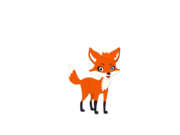
Fu is for Frieda Fox.
Prompt snippets
Frieda Fox is a female fox with a slender build, vibrant burnt-orange fur, and distinctive creamy-white "socks" on her paws and the tip of her bushy tail. Her face features large, expressive emerald-green eyes with thick eyelashes and a small, triangular black nose. Her ears are large and alert, tipped with black fur, and she sports a tuft of messy "hair" fur between them.
Characters with fu